Pages

Sunday, March 23, 2014

I/D3: Unit Q - Pythagorean Identities

INQUIRY ACTIVITY SUMMARY:


The formula in this unit is sin^2x+cos^2x=1. Thinking back to the unit circle, the Pythagorean Theorem is x^2+y^2=r^2. However, when put into the triangle in the unit circle, x=cos and y=sin and for "r" to be 1 we have to divide everything by r^2. We are then left with (x/r)^2+(y/r)^2=1 (are those ratios looking familiar?). Th ratio for cosine is (x/r) and the ratio for sine is (y/r), so we substitute cosine and sine for x and y respectively. That is how the formula sin^2x+cosine^2x=1 is derived. 


a) Deriving the identity with Secant and Tangent. Deriving from the sin^2x+cos^2x=1. Because we are looking for secant and tangent, which is the reciprocal of cosine and the ratio for tangent is y/x (sine over cosine), I would divide everything by cosine so that 1/cosine would be secant and the sine over cosine would be tangent.


b) Deriving the identity with Cosecant and Cotangent. Deriving from the sin^2x+cos^2x=1. Because we are looking for cosecant and cotangent, I would divide everything by tangent because sin because x/y (cosine over sin) is the ratio for cotangent and 1/sin is cosecant.


INQUIRY ACTIVITY REFLECTION:
  • The connections that I see between Units N, O, P, and Q so far are the Pythagorean theorem used from the Unit Circle from the Unit N and O can help us derive the formulas for Unit Q. Anther connection that is used throughout the units is the ratios, no matter what side length it is or if its a triangle not from the unit circle, the ratios remain the same throughout.
  • If I had to describe trigonometry in THREE words, they would be intimidating, confusing, and rewarding. Intimidating and confusing sort of combine together because once you first start trigonometry, you feel overwhelmed by the information so you feel confused. However, I also describe it as rewarding because then you start learning various ways to remember the formulas and find out how derivation can help you if you forget certain formulas. It's rewarding in a sense that you learn different ways to learn formulas and a way to use your knowledge to derive the formula out of information you already know.

Tuesday, March 18, 2014

WPP #13-14: Unit P Concept 6&7 - Applications of Law of Sines and Law of Cosines

Please see my WPP #13-14 made in collaboration with Molinda Av, by visiting their blog here. Also be sure to check out the other awesome posts on their blog.

Sunday, March 16, 2014

BQ#1 - Unit P - Law of Sines and Area of an Oblique Triangle

i. Law of Sines - We need the Law of Sines in order to find missing angle(s) and missing side(s) of a triangle that is not a right triangle. We can use trig functions to derive the Law of Sines.

Law of Sines: In the triangle ABC, SinA/a = SinB/b = SinC/c

When using the law of sines, we only use two out of the three.

You have a non-right triangle and draw a perpendicular line straight down the triangle from the angle B. That will be labeled "h" for height. Because we drew that perpendicular line, we now have two right triangles. We can now apply our trig skills.


To find the Law of Sines from the two triangles, we must use Sin. So using angle A, we have SinA = h/c (opposite over hypotenuse) and we have SinC = h/a (also opposite over hypotenuse). We then multiply each by the denominator to get rid of the ratio. We would then have cSinA=h and aSinC=h. Now, because both equal "h", that would also mean that they equal each other. So we set cSinA = aSinCWe and would then divide each by ac and that would cross out the a in aSinC and the c in cSinA. We would then be left with SinA/a = SinC/c.


iv. Area of an Oblique Triangle - We use this when we have SAS.

The area formula for a right triangle is A=1/2bh. The area of an oblique triangle is derived through also sin. For example, in this picture we will use angle C in the triangle that has a perpendicular line draw through it.


We have to find the "h" height. We know that sinC = h/a and that aSinC = h. So since we do not know what "h" is, we can substitute "h" for aSinC. Therefore, we would then get A=1/2baSinC. This relates to the original formula we are familiar with because it uses the same format of 1/2bh, but instead of being stuck with not know two variables (A and h), we can use our knowledge of the Law of Sines to see that h would equal aSinC and that we substitute aSinC (and the answer we have for aSinc) for "h".


Thursday, March 6, 2014

WPP #12: Unit O Concept 10 - Calculating Elevation and Depression

Outing at a Ski Resort!


a) Amber is at a ski resort with her friends. As they are admiring the view of the scenery from their balcony that is 125 feet above the ground, she sees her friend arriving late. She looks down at an angle of 48*. How far is the distance from her friend and herself?


You have to use sin to find the missing side. You have sin48 = 125/x. You have to rid of the x by itself, so you multiply both sides by x (to get it to the other side and get rid of the x on the bottom) and then divide both sides by sin48 to get the x by itself. 


b) Amber goes downstairs to help her friend bring up her luggage. Their other friend, Alex, calls to them from the balcony. Amber looks up at an angle of 63*. How far is the distance between Amber and Alex?


It is the same idea as part a; you have to solve for the missing side, so you must use sin. The x is on the bottom again so you multiply both sides by x and then divide everything by sin63 to get the x. 

*Students can either use the full height of 125 feet, or can assume that the eye level of the person is 5 feet and use 120 feet as the height as well.*


Tuesday, March 4, 2014

I/D #2: Unit O - Deriving the SRTs


INQUIRY ACTIVITY SUMMARY

30-60-90: The equilateral triangle has all 60* angles and is labeled to have the length of 1 on all sides. You are looking for a 30-60-90 triangle so you cut the triangle in half vertically. You will have a 30* angle, a 60* angle and a 90* angle.


You see that because you had cut the triangle in half, the side across from 30* is 1/2 and the side across from 90* is 1.


You then half to find the hypotenuse, so you use the Pythagorean Theorem to solve for the missing side. 


The side across from 60* ends up being radical 3 over 2. To get rid of the fractions, you multiply everything by 2. You end up with 30* being 1, 90* being 2 and 60* being radical 3. The "n" that is used is to express that any number can be put in place of "n". Meaning that the 30-60-90 triangle can have any lengths, bigger or smaller, than the triangle used in this example and that it will still have the same pattern as long as it is a 30-60-90 triangle. Through this pattern, when there is a 30-60-90 triangle, the side across 30* will be "n", while 90* will be 2 times "n" and 60* will be "n" times radical 3.


45-45-90: The equilateral square has sides all the length of 1. To change this into a 45-45-90 triangle, you have to cut it diagonally to get the 45-45 degree angles.


You see that because you had cut the square diagonally, both the side across from 45* and 45* are still 1. So now you have to use Pythagorean Theorem to solve for the missing side, 90*.


The missing side across 90* ends up being radical 2. The "n" is used to express that there are many numbers that can be used in "n" place. The lengths of the triangle can be longer or shorter than 1 and will still maintain the same pattern as long as it is a 45-45-90 triangle. Through this pattern, when there is a 45-45-90 triangle, the sides across from both 45* and 45* angles will be "n" while the side across form 90* angle will be n times radical 2.


INQUIRY ACTIVITY REFLECTION

Something I never noticed before about special right triangles is how the pattern is determined. I faintly remember how the Pythagorean Theorem was derived, but looking at how using the Pythagorean Theorem can help derive how the pattern is created is interesting.
Being able to derive these patterns myself aids in my learning because if for some reason I forget the pattern, I can draw the triangle/square and derive the pattern out and use that instead of guessing the pattern.

Saturday, February 22, 2014

I/D# 1: Unit N Concept 7 : Deriving the Unit Circle Activity

INQUIRY ACTIVITY SUMMARY

      1. The 30* triangle is one of the special right triangles (SRT). The rules of the 30* right triangle is that the leg opposite of the 30* is 1, the longer leg is radical 3, and the hypotenuse is 2. When using it in the Unit Circle you label the hypotenuse as "r", the leg opposite of the 30* is "y", and the longer leg is "x".

* The "r" has to be equal to 1 because when putting the triangle into the unit circle, the hypotenuse is the radius of the unit circle, that is why the hypotenuse of the triangle in the unit circle is 1.

http://dj1hlxw0wr920.cloudfront.net/userfiles/wyzfiles/1d8a68d5-a442-4626-bc06-e7346f455322.png

       
          The hypotenuse has to be one so you divide everything by 2 (because you are making the hypotenuse one) so that everything is equal. "r" becomes 1, "y" becomes 1/2, and "x" becomes radical 3 over 2.


      2. The 45* triangle is another SRT, the rules of the 45* right triangle is that the opposite leg of the angle is 1 and the other leg is also 1 while the hypotenuse is radical 2. When using it in the unit circle, the hypotenuse is "r", the leg opposite of the angle is "y" while the other leg is "x".


http://dj1hlxw0wr920.cloudfront.net/userfiles/wyzfiles/1d8a68d5-a442-4626-bc06-e7346f455322.png

            Again, because the triangle is used in the unit circle, we have to make the "r" 1. So we divide everything by radical 2. Because radical 2 over radical 2 is the same, then that becomes 1. For the other legs, you cannot have a radical on the bottom so you have to rationalize. You multiply the fraction by radical 2 on the bottom and the top. The radical cancels out on the bottom so you are left with 2 and on the top, 1 multiplied by radical 2 is just radical two. So for both "x"and "y", the answer is radical 2 over 2. 


      3. The 60* is the last SRT. The rules of the 60* is that the opposite leg is radical 3, the other leg is 1, and the hypotenuse is 2. When using the triangle you have to label the opposite leg "y", the other leg "x", and the hypotenuse "r".

http://dj1hlxw0wr920.cloudfront.net/userfiles/wyzfiles/1d8a68d5-a442-4626-bc06-e7346f455322.png


            You have to make the "r" one because this is being used in the unit circle (the hypotenuse is the radius of the unit circle) so you have to divide everything by 2 (you do one thing to one side, you have to do the same to the rest). "r" becomes 1, "y" becomes radical 3 over 2, and "x" becomes 1/2.


        4. The activity helps us derive the unit circle because it helps us see the reason why the 30* and 60* triangles have 1/2 and radical 3 over 2 and why 45* triangles have the radical 2 over 2 and 1/2. The shows us the process of how we get the coordinates also well once they are plotted on the graph. By putting the triangles on a graph that symbolizes the 1st quadrant and finding the coordinates, we see how the unit circle gets it's coordinates. It also becomes an easier way to remember the unit circle through the 3 triangles. By using the SRT, you really only have to memorize the 1st quadrant and find the rest of the coordinates in the unit circle by using reference angles. You just have to remember that the signs (+/-) change in each quadrant.

Example of what it should look like on a graph


        5. The quadrant that the activity lies in is the first quadrant. The changes in value as the triangles are in different quadrant change by their signs (+/-). The triangles on the unit circle are basically mirror images of each other. Quad 2 is a mirror of Quad 1, while Quad 3 is a mirror of Quad 2 and Quad 4 is a mirror of
Quad 3.


              The values of the triangles as it changes doesn't really change in the number value, but the sign of it changes. Using the ASTC, each letter being labeled counter-clockwise respectively, helps remind us which are positive and which are negative. "A" in the first quadrant means that all signs are positive. "S" in the second quadrant mean that only sin and csc are positive while tan, cot, cos, and sec are negative (the signs are +,- when looked at in x,y form). "T" in the third quadrant mean that only tan and cot are positive while sin, csc, cos, and sec are negative (signs are -,-). Lastly, in the "C" in the fourth quadrant means that cos and sec are positive while sin, csc, tan, and cot are negative. 

              The values stay true to the triangle that they are reference angles for. Any triangle with the reference angle of 30* is radical 3 over 2, 1/2. Any triangle with the reference angle of 45* is radical 2 over 2, radical 2 over 2. Any triangle with the reference angle of 60* is 1/2, radical 3 over 2.

30* is green
45* is red
60* is blue


http://dpmathematicssl.weebly.com/uploads/1/2/6/8/12680071/2763336_orig.png

HEADING FOR THIS SECTION: INQUIRY ACTIVITY REFLECTION

  1. The coolest thing I learned from this activity was the more efficient and easier way to memorize the Unit Circle. I always had trouble remembering the coordinates but now that I have connect the SRT to the UC, I see the pattern that the UC goes in.
  2. This activity will help me in this unit because we are finding exact values of trig functions and finding anlges when given exact values, so remember which quadrant has which positive and negative helps with the concept. It will also help on the test where we have to fill in the UC.
  3. Something I never realized before about special right triangles and the unit circle is how they connect. My college algebra teacher briefly went over the connection, but it never really clicked so I had to memorize the unit circle blindly. Doing this activity I realized how the SRT connect to the UC and why the coordinates are the numbers they are.
REFERENCES


  1. http://dj1hlxw0wr920.cloudfront.net/userfiles/wyzfiles/1d8a68d5-a442-4626-bc06-e7346f455322.png (This counts as the first three pictures because the original picture was one big picture, but I cropped it so that I could insert the pictures in the needed sections).
  2. http://dpmathematicssl.weebly.com/uploads/1/2/6/8/12680071/2763336_orig.png


Monday, February 10, 2014

RWA1: Unit M Concepts 4-6 - Conic Sections in real life

Parabolas

Definition: The set of all points that are equidistant from a given point, known as the focus, and a given line, known as the directrix. 

Properties: 

Algebraically: The parabola equation is (x-h)^2 = 4p(y-k) or (y-k)^2 = 4p(x-h). The square can only be on the x or the y and not on both. The 4p must be on the term that is not squared. From the equation, you can tell which direction the parabola is facing and what the parabola will look like. Sometimes the equation for a parabola won't be given to you in standard form, so remember that a parabola will always only have one squared term. 

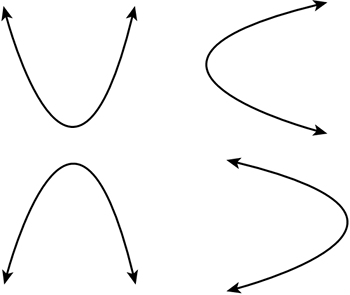
Graphically: The general shape of a parabola is a "U" shape. If the x term is squared, the the parabola will either face up or down, the p if it is positive, then the parabola will face up while if p was negative, it would face down. If the y term is squared, then it will face either left or right. If the p is positive, it will face to the left while if it was negative, it will face to the left. The graph will have a focus and a directrix that go above and below, respectively, in a distance based on p. The foci determines the overall shape of the parabola, if the focus is close to the vertex, then the parabola will be "skinny" while if the focus is farther away from the vertex, then the parabola will be "fatter". This is because the more away the focus is, the less the parabola is focused on the center.

How to find the key parts of a parabola: First, make sure that the equation is put into standard form by using completing the square with two variables. To find the vertex, you look at h and k, they are put into the coordinates h,k. The signs will be opposite of what they are in the equation. The value of  p is found by taking the coefficient in front of the term that is not squared and set it equal to 4p, you solve for p and that p will be the distance from the vertex to focus and from vertex to directrix. The axis of symmetry is usually the number that stays the same in your ordered pairs. It will either be x = # or y = #. 


Real World Application: There are several uses of parabolas, they are found in car headlights, satellite dishes, parabolic skis, the arch of a bridge, etc (http://www3.ul.ie/~rynnet/swconics/UP.htm). The parabola can be used in the dishes used to for cable for television. The shape of the parabola bounces the beams and waves from the sides of the parabola into the focus of the parabola. The reason for this is because the shape, it reflects the beam from whatever location from inside the parabola into the focus point. This gives good and strong signals.


References:
https://blogger.googleusercontent.com/img/proxy/AVvXsEi6yrC-h3whYf8XeD_L2knefMEbiEJ-WvAoAgT-Pm33bfWaW_kIf2gICSUs5l_1CoWZn6fx2Kd8DpAKvw9D8_qXXTxH5oM9KRe3RzKQ6Cc94gICMRmj_k0PZTH-6i9ZGlQMF9Xljrm_uBdddnbNX8hn8YXQB1T8W9M1lE5b8Z2oDvQyf4wSqoIXAqlWrCQ=
http://www3.ul.ie/~rynnet/swconics/UP.htm
http://www.youtube.com/watch?v=Djnwlj6OG9k